15 Amazon LP Questions Bar Raisers Use to Reject You
Amazon built its interview around 16 Leadership Principles. Every round (yes, the coding rounds too) opens with an LP question. Every interviewer tags notes to specific LPs. The Bar Raiser sits in from another team to hold the hiring bar, and they can veto your offer on LP signal alone.
One Bar Raiser veto kills the offer. They never met you in coding rounds, but their LP scoring outweighs every other signal.
You get the 15 LP questions that show up most in 2026, the cross-tagging matrix so one story covers three principles, STAR answers that show the shape, and the scoring sheet Bar Raisers fill out behind the glass.
The 16 Leadership Principles
For reference, the full list (memorize these):
- Customer Obsession
- Ownership
- Invent and Simplify
- Are Right, A Lot
- Learn and Be Curious
- Hire and Develop the Best
- Insist on the Highest Standards
- Think Big
- Bias for Action
- Frugality
- Earn Trust
- Dive Deep
- Have Backbone; Disagree and Commit
- Deliver Results
- Strive to be Earth's Best Employer
- Success and Scale Bring Broad Responsibility
L4-L6 candidates: focus on LPs 1-14. Amazon added the last two in 2021 and they show up rarely in SWE loops.
TL;DR — the top 15 questions
For position-zero featured snippet:
- "Tell me about a time you made a mistake." (Ownership)
- "Describe a time you had to deliver under a tight deadline." (Bias for Action, Deliver Results)
- "Tell me about a time you disagreed with your manager." (Have Backbone)
- "Describe a time you simplified a complex process." (Invent and Simplify)
- "Tell me about a time you missed a deadline." (Ownership, Deliver Results)
- "Describe a time you gathered data to make a decision." (Dive Deep, Are Right A Lot)
- "Tell me about a time you took on something outside your role." (Ownership, Bias for Action)
- "Describe a time you had to push back on a customer request." (Customer Obsession)
- "Tell me about a time you had to learn something quickly." (Learn and Be Curious)
- "Describe a time you had to make a decision with incomplete data." (Bias for Action, Are Right A Lot)
- "Tell me about a time you raised the bar for your team." (Highest Standards)
- "Describe a time you challenged the status quo." (Have Backbone, Think Big)
- "Tell me about a time you mentored someone." (Hire and Develop the Best)
- "Describe a time you had to choose between two good options." (Are Right A Lot)
- "Tell me about a time you saved money or resources." (Frugality)
Detailed answer structures below.
The LP-tagging matrix
Cross-tag every story you have to multiple LPs. One story can show Ownership AND Customer Obsession AND Bias for Action depending on which angle you open with. The matrix:
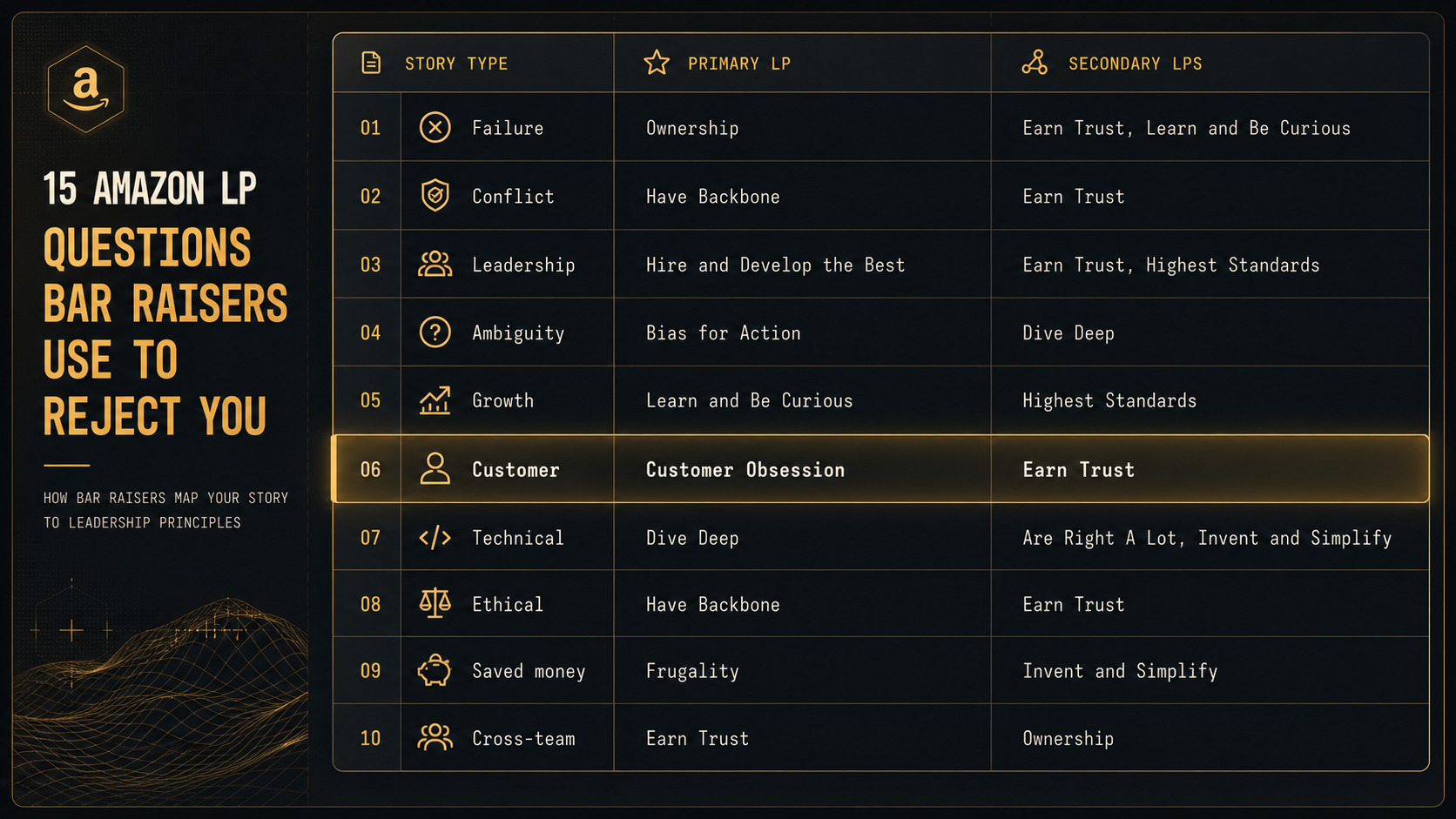
Tag every story in your library. When the interviewer drops an LP question, identify 2-3 stories that fit, then pick the one freshest in your memory.
A 12-story library cross-tagged across 14 LPs covers the entire loop. Without cross-tagging you'll repeat stories or run out by round three.
Question 1: "Tell me about a time you made a mistake"
Tags: Ownership (primary), Earn Trust, Learn and Be Curious.
What the interviewer wants:
- A real, consequential mistake.
- Explicit ownership ("I underestimated complexity," not "the team failed").
- Concrete recovery action.
- Specific learning that you've applied since.
Example STAR answer (90-second version):
- Situation: Q3 2024, leading a 4-engineer team on payments service rewrite.
- Task: Tech lead, accountable for delivery without latency regression.
- Action: I underestimated migration complexity by 30%. Hit a deadlock issue I couldn't diagnose at week 7. Escalated to a principal engineer at week 8. I should have escalated at week 5. We shipped at week 13 instead of week 10.
- Result: Shipped, but missed quarterly OKR. Manager flagged the slip in my next perf cycle.
- Learning: Now I escalate blockers within 48 hours, not 3 weeks. Used this on the next two projects, both shipped on time.
The Bar Raiser is checking: did you take ownership? Did you fix the underlying habit? Could you do this again?
Question 2: "Describe a time you had to deliver under a tight deadline"
Tags: Bias for Action (primary), Deliver Results.
What the interviewer wants:
- A concrete deadline (not "we were busy").
- Specific actions you took to compress the timeline.
- A delivered outcome.
Watch for: Bias for Action without quality. The Bar Raiser will probe "did the quality suffer?" Have an answer ready.
Question 3: "Tell me about a time you disagreed with your manager"
Tags: Have Backbone; Disagree and Commit (primary), Earn Trust.
What the interviewer wants:
- A real disagreement (not "I gently suggested").
- You raised it directly, not through a back channel.
- The "commit" half of "disagree and commit". Once decided, you executed even if the decision went against you.
Common trap: stories where you "disagreed" but never told the manager. That's avoidance, not Have Backbone.
Question 4: "Describe a time you simplified a complex process"
Tags: Invent and Simplify (primary), Highest Standards.
What the interviewer wants:
- A complex process you inherited or created.
- A specific simplification.
- Quantified impact (LOC removed, build time reduced, deploys/week increased).
Example angle: "I removed our Jenkins job that had grown to 800 lines of bash by replacing it with a 40-line GitHub Actions workflow. Build time dropped from 18 minutes to 4."
Question 5: "Tell me about a time you missed a deadline"
Tags: Ownership (primary), Deliver Results.
Variation on Question 1. Different framing emphasizes Deliver Results. Have a separate story or be ready to reframe.
Question 6: "Describe a time you gathered data to make a decision"
Tags: Dive Deep (primary), Are Right A Lot.
What the interviewer wants:
- A non-trivial decision (architecture, prioritization, hire/no-hire).
- Specific data you gathered (logs, metrics, user research, surveys).
- The data changed your initial intuition. Bar Raisers love this. It shows intellectual humility.
Question 7: "Tell me about a time you took on something outside your role"
Tags: Ownership (primary), Bias for Action.
What the interviewer wants:
- You saw a gap that wasn't anyone's job.
- You filled it without being asked.
- The outcome was real and benefited the team/org.
Avoid: "I took on additional features I was assigned." That's not outside your role. That's just doing your job.
Question 8: "Describe a time you had to push back on a customer request"
Tags: Customer Obsession (primary), Earn Trust.
The trick: you're advocating for the customer's true interest, not ignoring their request. Two different things.
Example angle: "A customer asked for a feature that would have introduced a security vulnerability for all our users. I explained why we couldn't ship it as requested, then proposed an alternative that met their underlying need without the vulnerability."
Question 9: "Tell me about a time you had to learn something quickly"
Tags: Learn and Be Curious (primary), Highest Standards.
What the interviewer wants:
- A skill or domain you didn't have at time T.
- A specific learning approach (you didn't just "read about it").
- An outcome that demonstrates you actually learned it.
Question 10: "Describe a time you had to make a decision with incomplete data"
Tags: Bias for Action (primary), Are Right A Lot.
What the interviewer wants:
- A decision with stakes.
- Limited information at decision time.
- Your reasoning for moving forward despite the gap.
- Reflection on whether you were right.
Bar Raiser scoring: this is a high-leverage Are Right A Lot question. Demonstrate calibrated confidence.
Question 11: "Tell me about a time you raised the bar for your team"
Tags: Insist on the Highest Standards (primary).
What the interviewer wants:
- A specific bar you raised (code review standards, on-call rotation, test coverage, postmortem quality).
- How you raised it. You instituted a process, you didn't just complain.
- Adoption (the team kept it).
Question 12: "Describe a time you challenged the status quo"
Tags: Have Backbone (primary), Think Big.
What the interviewer wants:
- A status quo that was suboptimal but tolerated.
- Your specific challenge (not just "I suggested change").
- The outcome.
Question 13: "Tell me about a time you mentored someone"
Tags: Hire and Develop the Best (primary).
What the interviewer wants:
- A specific mentee.
- Specific actions you took (regular 1:1s, code review feedback, project shadowing).
- The mentee's growth (concrete signal: promoted, shipped a project, took on something they couldn't have before).
For L5+ candidates, this is high-leverage. L4 candidates can substitute "mentored an intern."
Question 14: "Describe a time you had to choose between two good options"
Tags: Are Right A Lot (primary).
What the interviewer wants:
- Two genuinely good options (not "good vs bad").
- Your reasoning framework.
- Reflection on whether you were right.
Question 15: "Tell me about a time you saved money or resources"
Tags: Frugality (primary), Invent and Simplify.
What the interviewer wants:
- A real saving (dollars, compute, time).
- Your specific action.
- The amount.
Frugality is the most underprepared LP. Have one solid story. Examples: rewrote a query costing $50K/month in BigQuery, switched from on-demand to spot instances saving $200K/year, replaced a paid tool with an OSS equivalent.
What Bar Raisers actually score
Bar Raiser feedback is structured. The scoring categories:
- LP demonstrated. Did the story actually show the LP, or was it tangentially related?
- Specificity. Concrete details (names of roles, dates, metrics) versus hand-wavy ("we improved things").
- Ownership. Did you own your role or blame others?
- Calibrated reflection. Did you reflect with appropriate humility, or come off falsely modest or self-aggrandizing?
- Coherence with other rounds. Do your behavioral signals match your technical signals? If you claimed Ownership in behavioral but argued passively in coding, that's incoherent.
That fifth point is why behavioral coherence matters across the loop. Every interviewer's notes hit a committee that reads them in random order.
How to prepare for the Amazon loop specifically
A 4-week Amazon-specific behavioral plan:
- Week 1: Draft 6 stories spanning the most-asked LPs (Ownership, Bias for Action, Have Backbone, Customer Obsession, Dive Deep, Deliver Results).
- Week 2: Draft 6 more (Invent and Simplify, Earn Trust, Learn and Be Curious, Are Right A Lot, Highest Standards, Think Big).
- Week 3: Cross-tag the 12 stories to multiple LPs using the matrix. Add 2 backup stories for the most-asked LPs.
- Week 4: Run mock LP rounds with Claude voice-mode in FaangCoder or with a partner. Practice follow-up handling.
For the broader Amazon interview prep, see Amazon Software Engineer Interview Questions 2026.
Common Amazon behavioral mistakes
Mistake 1: Generic "team" stories. "We delivered the project." Fix: every story must be about what YOU did.
Mistake 2: Stories without metrics. "It worked." Fix: "Deploy time dropped 60%, on-call pages dropped from 12/week to 3/week."
Mistake 3: One story per LP. Fix: 2 stories per LP minimum, cross-tagged.
Mistake 4: Stories from old companies. Fix: at least half your stories should be from the last 24 months.
Mistake 5: Forgetting the LP. Fix: open every answer with the LP frame. "This is an example of Bias for Action..."
Mistake 6: Long preamble. Fix: 15-20 seconds for Situation, then move.
FAQ
How many LPs will I be asked about in a typical Amazon loop? 8-12 across a standard 4-round loop. Each round covers 2-3 LPs. The Bar Raiser round covers 4-5.
Are some LPs asked more than others? Yes. Customer Obsession, Ownership, Bias for Action, Have Backbone, and Dive Deep are the top 5 by frequency.
Should I memorize the LP definitions? Yes. The Bar Raiser will sometimes ask "which LP do you think this story demonstrates?" Have an answer.
What if I don't have a story for an LP? Manufacture one from a smaller event. A "Frugality" story can be about any small saving, not a $1M optimization.
Can I use the same story for multiple LPs? Yes, with reframing. The cross-tagging matrix above is exactly this.
Is the Amazon loop harder than other FAANG? Different. Amazon is heavier on behavioral than other FAANG. Technical bar is comparable.
The verdict
Amazon behavioral is winnable with 4 focused weeks. 12 stories cross-tagged to 12-14 LPs, three rehearsed lengths each, follow-up playbook ready. The Bar Raiser model means every round matters. You can't slack on the early ones.
If you found this useful, FaangCoder helps candidates iterate to optimal solutions in real interviews. That includes Amazon-specific LP behavioral mock practice with Claude 4.7 voice-mode. $399 lifetime ($199/mo monthly option). See the Solve demo, or join the Discord to talk to other candidates prepping for Amazon.