Google's 2026 Loop Killed Your 2022 Prep. Here's the Fix.
The Google software engineer interview in 2026 is the most-changed loop in FAANG. Google rolled out Gemini-paired AI-allowed rounds in Q3 2025, expanded the Googleyness round into a structured rubric, added scaled-down system design at L4 phone screens, and quietly shortened the standard onsite from 5 hours over 2 days to 4 hours in a single virtual block. Prepping for Google with 2022 advice? You're prepping for an interview that no longer exists.
Six structural changes in 18 months. The 2022 Google loop you read about on Glassdoor is gone — half the rounds and every rubric have been rewritten.
You get the 2026 loop format, the top 30 LeetCode problems Google asks (from our 800+ Discord-tracked dataset), the Googleyness round breakdown, the leveling rubric L3-L7, and the company-specific prep plan for the 2026 reality.
TL;DR — the 2026 Google loop
For position-zero featured snippet:
The Google SWE loop in 2026:
- Recruiter screen (30 min, behavioral + light technical)
- Phone screen (45 min, 1 coding problem + 5 min behavioral). At L4+ now includes a 10-min scaled-down SD probe.
- Onsite (4 hours virtual, single day):
- Coding round 1 (45 min, AI-disallowed)
- Coding round 2 (45 min, Gemini-allowed at L4+)
- System design (60 min, L5+; scaled-down at L4)
- Googleyness + Leadership (45 min, behavioral)
- Hiring committee review (asynchronous, 1-2 weeks)
- Team match + offer (2-4 weeks)
Total time from first contact to offer: typically 6-10 weeks.
What changed at Google in 2025-2026
Six significant shifts:
- Gemini-paired round. Standard at L4+ since Q3 2025. Use Gemini for one of two coding rounds.
- Googleyness 2.0 rubric. Structured scoring across 4 axes: collaboration, growth orientation, comfort with ambiguity, psychological safety contributions.
- System design at L4. Scaled-down SD probe in the phone screen for L4 candidates ("design a URL shortener for 10K users").
- Loop compressed. 4 hours single day versus 5-7 hours over 2 days in 2022.
- Hiring committee shifted weight. HC now reads behavioral notes with equal weight to technical notes. Used to be 60/40 technical/behavioral in 2022.
- Phone screens shortened to 35 min for L3 candidates (kept at 45 min for L4+).
The top 30 Google LeetCode questions
By frequency from our 2024-Q1 2026 dataset of Google interview reports.

Pattern distribution:
- BFS/DFS/Graph: ~35% of Google questions
- Trees: ~20%
- DP: ~15%
- Binary Search (incl. on answer): ~10%
- Sliding Window / Two Pointers: ~10%
- Other (Heap, Trie, Mono Stack): ~10%
Got 4 weeks for Google prep? Focus on graphs, trees, and binary-search-on-answer. They cover ~60% of asked questions.
The phone screen (45 min)
Format:
- 5 min behavioral preamble
- 30 min coding (1 problem)
- 5 min Q&A
- 5 min wrap
For L4+ as of 2025, an additional 10-min scaled-down SD probe at the end. Add this to your prep.
What Google interviewers look for in the phone screen:
- Clean code. Not clever code. The interviewer reads it later for the committee write-up.
- Articulation. Can you explain trade-offs in 60 seconds?
- One pivot. Can you handle a follow-up that changes the problem ("now what if the input is 10x larger")?
- Honesty. "I haven't seen this before, let me think" beats "I think I remember this."
The onsite — coding round 1 (AI-disallowed, 45 min)
Standard coding round. One problem. Active proctoring (screen-share + camera).
Format:
- 5 min clarifying questions + examples
- 15-20 min coding
- 5 min dry run
- 10 min optimization discussion + complexity analysis
- 5 min Q&A
Common Google L4 rounds: tree problems, graph problems, sliding window, two pointers.
Common Google L5+ rounds: DP, system design, harder graph, binary search on answer.
The onsite — coding round 2 (Gemini-allowed, 45 min)
The 2026 Gemini-paired round. Use Gemini for the coding round.
What the interviewer evaluates:
- Prompt quality. Can you frame the problem well on first try?
- Acceptance discipline. Do you read Gemini's output critically before pasting?
- Recovery. When Gemini gives a wrong-direction answer, can you redirect in 30 seconds?
- Articulation. Can you compress Gemini's verbose output to 30-second explanation in your own words?
- Strategic delegation. Which subtasks do you give to Gemini vs keep in your head?
Practice this differently from the AI-disallowed round. Different muscle memory. FaangCoder voice-mode pairs you with Claude 4.7 for AI-paired round practice. Same workflow, just Claude instead of Gemini.
The onsite — system design (60 min)
L5+ standard. L4 gets a scaled-down version (45 min) at L4 onsite.
Use the RESHADED framework. Common Google SD prompts:
- Design Google Drive (file sync + chunking)
- Design Google Docs (collaborative editing, OT/CRDT)
- Design YouTube (video streaming)
- Design Google Maps (geospatial + ETA)
- Design URL Shortener (the L4 baseline)
- Design Web Crawler (BFS-based, distributed)
Google-specific deep-dive emphasis: consistency models, multi-region replication, capacity planning math.
The Googleyness round (45 min)
The 2024 Googleyness rubric (rolled out late 2024) scores across 4 axes:
- Collaboration. Can you work effectively with cross-functional partners?
- Growth orientation. Do you actively seek to improve?
- Comfort with ambiguity. Can you operate when the problem isn't fully specified?
- Psychological safety contributions. Do you contribute to a safe team environment?
Sample questions:
- "Tell me about a time you had to work with someone whose style was very different from yours." (Collaboration)
- "Describe a skill you didn't have a year ago that you have now." (Growth)
- "Tell me about a project that started ambiguous." (Ambiguity)
- "Describe a time you helped a teammate who was struggling." (Psychological safety)
Use the behavioral pillar's STAR-L framework. 12 stories covering 8 archetypes. Cross-tag to the 4 Googleyness axes.
The hiring committee
After your loop, your packet (interviewer notes + your code submissions) goes to the Hiring Committee, which is a rotating panel of senior engineers from across the company.
Key facts:
- HC reads behavioral notes with equal weight to technical (changed in 2024).
- A single weak round can be offset by strong other rounds.
- HC produces a recommendation: Hire / No Hire / Hire at Lower Level.
- HC review takes 1-2 weeks.
What HC looks for:
- Coherence across rounds. Behavioral and technical signals should reinforce each other.
- Clear hire signal in 3+ rounds. Borderline rounds get less weight.
- No flagged red flags. A single "Strong No Hire" with a specific concern (rude to interviewer, ethical concern) can sink the packet.
Leveling rubric L3-L7
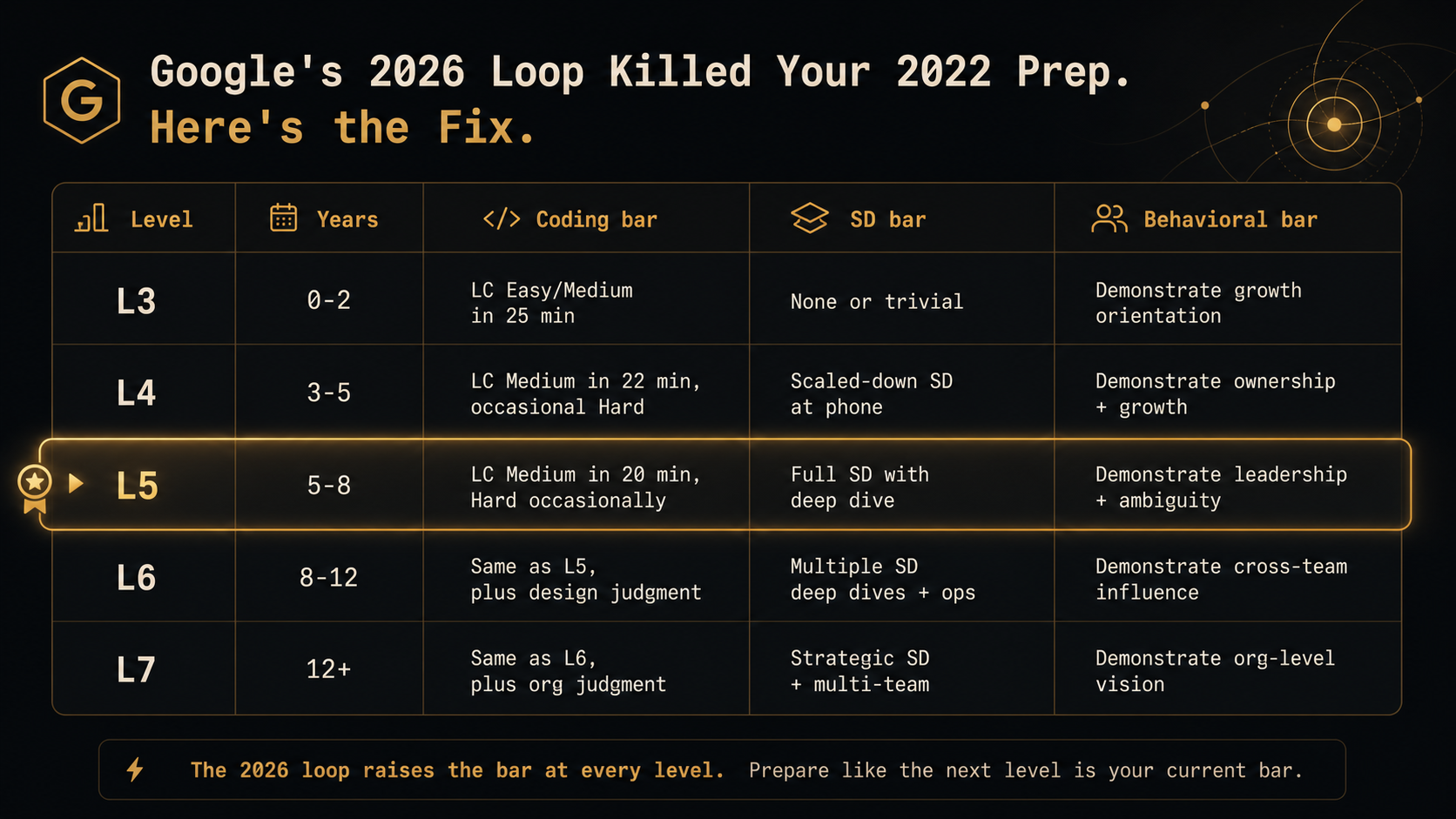
Apply L4 and walk an L5-quality round? You've cleared the bar. Apply L5 and walk an L4-quality round? You might be downleveled to L4.
The HC now reads behavioral notes with equal weight to technical. Coherence across rounds matters more than peak performance in any single round.
Google-specific prep plan (8 weeks)
Google as your target? An 8-week sprint:
- Week 1-2: Patterns + Top 30 Google LC list (Tier 1 problems).
- Week 3-4: Continue Top 30 + system design primer (RESHADED framework + 3 designs).
- Week 5: Googleyness behavioral library (8 stories cross-tagged to 4 axes).
- Week 6: Gemini-paired round practice. Pair with FaangCoder for live AI-paired mocks.
- Week 7: Mock interviews. interviewing.io paid mocks for calibration.
- Week 8: Taper. 1 mock per day. Sleep optimization.
For the broader 16-week plan, see How to Prepare for a FAANG Interview.
What to skip for Google
Don't waste time on:
- Amazon Leadership Principles. Different company, different rubric.
- Backtracking grinding (Google asks backtracking ~2% of the time).
- Bit manipulation (Google asks ~1%).
- Cracking the Coding Interview's Chapter 17 (advanced). Overlap with Google rotation is minimal.
Common Google interview mistakes
After watching candidates fail Google loops:
Mistake 1: Underprep on graph problems. Google asks graphs ~35% of the time. Weak graph fluency means you fail.
Mistake 2: Skipping system design at L4. The 2025 change made SD relevant at L4. Many candidates miss this.
Mistake 3: Performative AI refusal in Gemini round. Per our 2026 shift analysis, refusing AI in the AI-allowed round reads negatively.
Mistake 4: Generic Googleyness answers. "I'm a team player" without specifics. Fix: cross-tag stories to the 4 Googleyness axes.
Mistake 5: Over-clever code. Google interviewers grade code clarity heavily. One-liner Python with comprehension chains loses points.
FAQ
How hard is the Google interview compared to Meta/Amazon? Slightly harder on technical breadth (more graph + tree variety). Slightly easier on behavioral (Googleyness is structured but not as deep as Amazon's Bar Raiser).
Do I need to know Google's tech stack (Spanner, Borg, etc.)? No, but knowing the names earns minor points. Don't fake expertise.
Is the Gemini round mandatory? For L4+, yes. You can technically refuse to use Gemini, but it reads negatively per recruiter feedback.
How long does the loop take from first contact to offer? 6-10 weeks typically. HC review is the rate-limiter (1-2 weeks).
Can I retry if I get No Hire? Yes, after a 12-month cooldown.
What's the most important Google round? System design at L5+. Coding rounds 1+2 score similarly. SD has the highest variance and decides leveling.
The verdict
The 2026 Google loop is shorter (4 hours), harder (Gemini round + Googleyness rubric + L4 SD), and more structured than the 2022 loop. Prep accordingly. Focus on graphs, trees, and binary-search-on-answer for coding; RESHADED + 3 designs for SD; 8 stories cross-tagged to Googleyness axes for behavioral.
If you found this useful, FaangCoder helps candidates iterate to optimal solutions in real interviews. That includes Gemini-equivalent AI-paired round practice with Claude 4.7. $399 lifetime ($199/mo monthly option). See the Solve demo, or join the Discord to talk to other candidates prepping for Google.