16-Week FAANG Prep Plan That Actually Works in 2026
Most FAANG prep guides on the internet were written between 2018 and 2022. They optimize for an interview format that no longer exists. They tell you to grind 600 LeetCode problems and skip behavioral. They tell you system design only matters at L5. They were right then. They're wrong now.
This is the 2026 version. Sixteen weeks, four phases, week-by-week. The 50/30/20 prep mix that reflects post-ChatGPT FAANG bars. The exact problem list per week. The mock cadence. The "tools you actually need" checklist with 2026-current pricing.
A senior engineer wrote this. Someone who's both passed FAANG loops as a candidate and sat on the other side of the table. Plan-first, no fluff. You're a smart engineer who needs the schedule and not the motivation.
Who this guide is for
Three reader personas. Skip to your section.
- New grad or career-start candidate (graduating CS major, bootcamp finisher, or first SWE job seeker). Skip to Phase 1.
- Laid-off comeback engineer (5-10 years experience, recently laid off, hasn't interviewed in 3+ years). Skip to "What's changed since you last interviewed."
- Senior level-up (L5+ trying to break into L6 staff or jump from a non-FAANG to FAANG at the same level). Skip to "Senior calibration check."
Honest disclaimer: this is a 16-week plan. Got 4 weeks because a recruiter just emailed you? See Sprint Mode near the end. Got 6 months because you're employed and grinding slow? See Marathon Mode. Don't compress phases beyond what's mapped here. Failure mode is burnout in week 10 and a shaky onsite in week 16.
TL;DR — the 4-phase plan
For position-zero featured snippet purposes, the plan in 60 seconds:
- Phase 1 (weeks 1-4): Foundations. Pattern overviews + Blind 75 + 6 behavioral stories drafted in STAR format. Daily cadence: 2 hours weekday, 4 hours weekend. About 14 hours/week.
- Phase 2 (weeks 5-8): Volume. NeetCode 150 grind + system design primer + 12 behavioral stories polished. Daily cadence: 2.5 hours weekday, 5 hours weekend. About 17 hours/week.
- Phase 3 (weeks 9-12): Mocks. 1 mock interview every 2 days + company-specific cramming. Mock platforms: Pramp, interviewing.io, FaangCoder voice-mode.
- Phase 4 (weeks 13-16): Taper. 1 mock per day + sleep optimization + offer-day prep.
Committed enough to read past this paragraph? The rest is the operational manual.
The 50/30/20 prep mix and why it changed
In 2022, the optimal FAANG prep allocation for a typical L4 candidate was approximately:
- 80% LeetCode / DSA
- 15% system design
- 5% behavioral
In 2026 the optimal mix is:
- 50% LeetCode / DSA / pattern fluency
- 30% system design
- 20% behavioral
Three forces drove the shift. AI commoditized rote LeetCode memorization, so interviewers shifted weight to harder-to-fake signals. Behavioral coherence under live questioning is the new high-signal filter. System design moved earlier in the funnel. Even L3-L4 phone screens now include scaled-down SD questions. Full justification in What Changed in FAANG Interviews After ChatGPT.
The 80/15/5 ratio that worked in 2022 is now 50/30/20. Behavioral and SD ate 30 points of LeetCode's weight in three years.
Honest caveat by level:
- L3 new grad: 65% LC / 20% SD / 15% behavioral. Less work history to articulate.
- L4 mid: the canonical 50/30/20.
- L5 senior: 40% LC / 35% SD / 25% behavioral.
- L6+ staff/principal: 30% LC / 40% SD / 30% behavioral.
Time-block your prep around your level. The biggest mistake we see: L5+ engineers using L4 prep ratios.
Phase 1 — Foundations (Weeks 1-4)
Phase 1 is breadth, not depth. You're building the recognition layer. See a problem, classify it instantly: sliding-window-variable-size or binary-search-on-answer? That recognition speed is what you grind in Phase 1.
Week 1: Patterns overview + easy warmups. Read the Top 23 LeetCode Patterns pillar. Solve LC 1 (Two Sum), 20 (Valid Parens), 21 (Merge Sorted Lists), 26 (Remove Duplicates), 121 (Buy/Sell Stock), 125 (Valid Palindrome), 136 (Single Number), 217 (Contains Duplicate), 242 (Valid Anagram). Nine easies that establish pattern fluency without burning you out. Each problem: solve in 15 minutes. Can't? Peek at the editorial, understand it, then re-solve from scratch the next day.
Week 2: Sliding window + two pointers. Solve LC 3, 11, 15, 76, 167, 209, 283, 567. Read the Sliding Window Pattern Guide. Two-pointer adjacent reading: Two Pointers Pattern Guide. End of week 2 you should identify a problem as sliding-window or two-pointer in under 60 seconds of reading.
Week 3: Trees + BFS/DFS. Solve LC 102 (Level Order), 104 (Max Depth), 110 (Balanced Tree), 200 (Number of Islands), 226 (Invert Tree), 235/236 (LCA), 543 (Tree Diameter), 695 (Max Area Island). BFS/DFS is one of the highest-leverage patterns in the corpus. It shows up in graphs, trees, grids, even backtracking variants.
Week 4: First 3 behavioral stories drafted in STAR format. Pick: failure, conflict, leadership. Draft each in three lengths (90 seconds, 3 minutes, 5 minutes). Record yourself telling each one. Listen back. Cringe. Rewrite. Uncomfortable but the highest-leverage hour of week 4.
Daily cadence Phase 1: 2 hours weekday, 4 hours weekend. Average 14 hours/week. Don't exceed this in Phase 1. You'll need the energy in Phase 3.
Phase 2 — Volume (Weeks 5-8)
Phase 2 is where you build depth. The patterns from Phase 1 should be fluent now. In Phase 2 you grind the medium and hard variants until you solve them under interview time pressure.
Week 5: Dynamic programming foundations. Solve LC 70 (Climbing Stairs), 198 (House Robber), 322 (Coin Change), 300 (LIS), 1143 (LCS). Read the DP Patterns Guide. DP is the pattern most candidates fear. The 7-pattern framework collapses 90% of it.
Week 6: Graphs + topological sort. Solve LC 207 (Course Schedule), 210 (Course Schedule II), 261 (Graph Valid Tree), 269 (Alien Dictionary), 332 (Reconstruct Itinerary). Topological sort is the most common L4+ FAANG graph problem. Write Kahn's algorithm from memory in 7 minutes and you've cleared a major bar.
Week 7: System design primer. Read ByteByteGo Vol 1 chapters 1-4. Watch Hello Interview's "Design Twitter" video on YouTube. Draft your first SD whiteboard answer: design a URL shortener for 10K users. Time yourself: 35 minutes from clarifying questions to capacity estimation to high-level diagram to deep-dive on one component. This is your baseline for the System Design Pillar.
Week 8: Behavioral story polish. Get to 12 stories total covering all eight archetypes (failure, conflict, leadership, ambiguity, growth, customer, technical, ethical) with at least one backup per category. Run through them with a friend or with Claude voice-mode. The interviewer will probe with follow-ups. Rehearse the most likely follow-up for each story.
Daily cadence Phase 2: 2.5 hours weekday, 5 hours weekend. Average 17 hours/week. Slip below 14 hours/week in Phase 2 and your Phase 3 mock pass rate will reflect it.
Phase 3 — Mocks (Weeks 9-12)
Phase 3 is where you find out where you actually are. Mocks are the only honest signal because they recreate the time pressure, the awkward silences, the "wait, can I clarify?" moments that solo prep doesn't.
Mock cadence Phase 3: 1 mock every 2 days. Mix: 4 LC mocks, 3 SD mocks, 2 behavioral mocks per week. Breakdown matters. Don't over-index on LC mocks just because they're more comfortable.
Mock platforms:
- Pramp (free): peer mocks. Variable quality. Good for volume.
- interviewing.io (paid, $225 per 2-hour block): mocks with ex-FAANG engineers. Calibrated to actual FAANG bars. Use for at least 4 mocks across Phase 3.
- FaangCoder voice-mode: 24/7 AI-mock. Soft pitch: no scheduling, run a mock at 2am the night before an onsite, $399 once instead of $225 per session. After 4 sessions the math wins. See the demo.
Week 9-10: Generic FAANG calibration mocks. Don't specialize yet. Run a Google-style mock, a Meta-style mock, an Amazon-style mock. Find your weak archetype.
Week 11-12: Company-specific cramming. Applying Google? Read Google Coding Interview Questions 2026. Meta? Meta Coding Interview Questions 2026. Each company guide has a tagged list of the top 30 problems for that company plus the 2026-specific loop format.
Failure mode: mock pass rate below 50% by week 11? Extend Phase 3 by 2 weeks. Don't compress. The cost of one wasted onsite (lost momentum, recruiter cooldown of 6-12 months) is much higher than 2 extra weeks of prep.
Phase 4 — Taper (Weeks 13-16)
The taper is where most candidates blow it. Over-prep means peak fatigue at week 15. Under-prep means losing recognition speed. The right taper is high mock cadence + low total volume.
Mock cadence Phase 4: 1 mock per day. 4 LC mocks, 2 SD mocks, 1 behavioral mock per week. Lower total time per mock. You're maintaining sharpness, not building.
Sleep + nutrition: treat the loop like a marathon. 8 hours sleep, no sugar crashes, no caffeine binging the morning of an interview.
Offer-day prep: review your behavioral library 1 hour before the loop starts. One easy LC warmup. Arrive 15 minutes early. Water plus a 200-cal snack between rounds.
Post-loop: decompress 24 hours. Don't catastrophize one bad round. Committee weighs all rounds. The Bar Raiser model means a single 4/5 round can be offset by four 5/5 rounds. Don't post-mortem until you have all the data.
The toolkit (what you actually need)
Don't overbuy. Here's the stack we recommend.
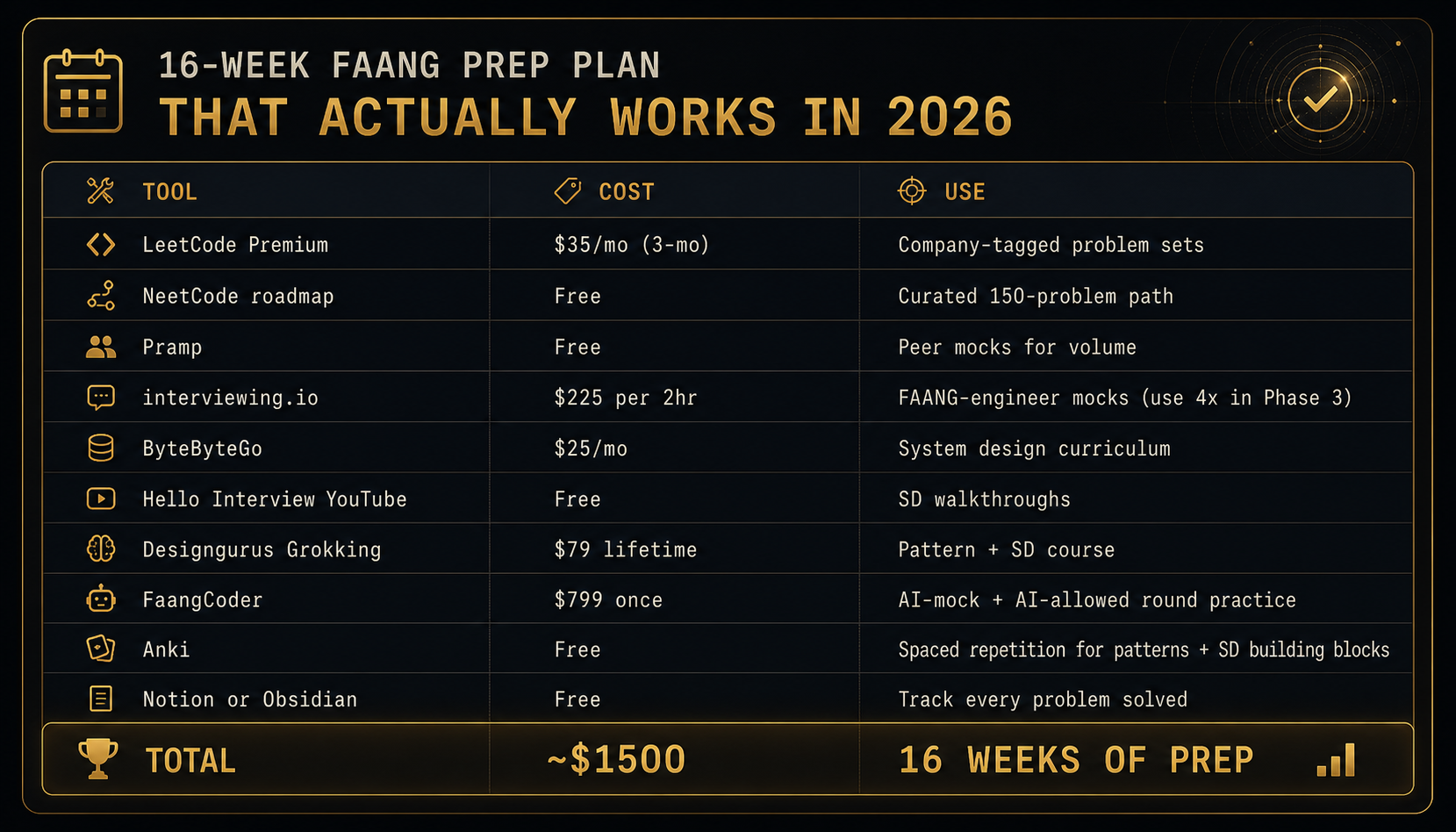
About FaangCoder specifically: a native desktop overlay that pairs you with Claude 4.7 (1M context) for live AI-paired practice and 24/7 mock interviews. Soft pitch: $399 lifetime, per-hour cost beats interviewing.io after 7 mocks. Try the Solve demo to see the workflow.
The "what to skip" list
Equally important as what to use: what to avoid.
- Skip Cracking the Coding Interview cover-to-cover. Use it as a reference, not a curriculum. The 2015 problem selection underweights 2026 patterns.
- Skip random YouTube DSA tutorials older than 2 years. Patterns evolved. The "binary search on answer" pattern barely existed as a named template in 2020.
- Skip generic "100 days of code" challenges. They optimize for streak, not quality.
- Skip $5,000 bootcamps. Marginal value over self-study + $399 FaangCoder is negative for a candidate with 1+ years of experience.
- Skip "memorize Sean Prashad's 173 list." Memorization without pattern fluency is AI-replaceable signal. Use the list as a recognition drill, not a memorization drill.
- Skip /r/cscareerquestions during prep. Most posters are humblebragging or doom-spiraling. Both are toxic to your prep mindset.
Sprint Mode — 4-6 weeks if you have a fast offer cycle
A recruiter just emailed you and the loop is in 5 weeks?
- 6 hours per day, 6 days a week.
- Cut SD to 15%. Cut behavioral to 10%.
- 75% LeetCode focus on the Blind 75 specifically.
- Skip Phases 1-2. Jump straight to Phase 3 mocks at week 2.
- Keep Phase 4 taper intact (last 5-7 days).
Caveat: sprint mode is suboptimal. Mock pass rates in sprint mode run lower because there's no time for behavioral library development. Negotiate the loop to 8+ weeks out if you can.
Marathon Mode — 6+ months if you're employed and grinding slow
Employed and prepping while working full-time?
- 1 hour per day weekday + 4 hours per weekend day. About 12 hours/week.
- Pad Phase 1 to 8 weeks, Phase 2 to 12 weeks, Phase 3 to 8 weeks, Phase 4 to 4 weeks. Total 32 weeks.
- Mandatory rest day each week. Burnout in marathon mode is the #1 failure mode.
- Stack a vacation day at the start of each phase transition for a 4-day intensive sprint.
Common pitfalls (and how to avoid them)
After observing hundreds of candidates in our Discord, the same five pitfalls recur.
Pitfall 1: Solving 600 LeetCode without learning patterns. Symptom: solve LC 76 (Min Window Substring) on attempt one but freeze on LC 567 (Permutation in String) because you don't recognize it as the same pattern. Fix: pattern-first, problem-second. Read Top 23 LeetCode Patterns before grinding. Tag every problem you solve with its pattern in your tracking sheet.
Pitfall 2: No mock interviews until week 14. Symptom: solved 200 problems but freeze in your first Pramp mock because you've never had to think out loud under time pressure. Fix: start mocking week 9. The earlier you fail in mocks, the more you learn.
Pitfall 3: Skipping behavioral until the week before onsite. Symptom: polished STAR story for "tell me about a time you led a project" but stumble on "tell me about a time you disagreed with a peer" because you only drafted one story per archetype. Fix: 12 stories drafted by week 8. Two per archetype, with one backup.
Pitfall 4: Burning out at week 10. Symptom: start to dread opening LeetCode. Problem-solving speed drops 30%. You start "studying" while watching Netflix. Fix: 1 day per week of zero prep. Mandatory. Block it on your calendar in week 1.
Pitfall 5: Comparing yourself to /r/cscareerquestions. Symptom: read about a 22-year-old who got 7 FAANG offers and feel inadequate. Fix: stay off the subreddit during prep. Track only your own progress against your week-by-week plan.
Calibration check — am I ready?
Honest checkpoints to validate your progress.
- At week 4: can you solve any of the Blind 75 in under 25 minutes, explaining out loud? If yes, on track.
- At week 8: can you solve a NeetCode 150 medium in under 35 minutes including thinking-aloud + dry run? If yes, on track.
- At week 12: can you pass a Pramp mock with a "would refer" rating? If yes, on track.
- At week 16: mock pass rate above 70%, behavioral library polished, system design template muscle memory. Ready for the real loop.
Fail any checkpoint? Don't panic. Identify the gap, extend that phase by 1-2 weeks, re-test. The plan is a guideline, not a contract.
Senior calibration check (L5+)
Senior candidates: calibration is different. Your bar is system design quality and behavioral coherence as much as LeetCode speed.
- At week 4: walk through a "Design YouTube" SD whiteboard in 45 minutes covering capacity estimation, high-level diagram, and one deep-dive? On track.
- At week 8: tell a 5-minute behavioral story about a project where you led 3+ engineers, with concrete metrics (latency dropped 30%, deploys increased 4x, cost dropped $200K/year)? On track.
- At week 12: handle the "design WhatsApp at L6 scale" follow-up where the interviewer probes consistency versus availability trade-offs in real time? On track.
What's changed since you last interviewed (for P3 comeback engineers)
Haven't interviewed since 2021? The loop has changed in twelve specific ways. Full breakdown in What Changed in FAANG Interviews After ChatGPT. The most important shifts for a comeback engineer:
- Behavioral weight jumped 10-15 points. Drafting your behavioral library is now the highest-leverage thing you can do in your first 2 weeks of prep.
- System design moved earlier. Even L4 phone screens now include scaled-down SD.
- AI-allowed rounds are standard. You need to practice with AI in some rounds and without in others.
- Phone screens are 25 minutes, not 45. Decisions are deterministic, not probabilistic.
After the loop
Got the offer?
- Read the negotiation guide. $50K+ is on the table for any L4+ offer if you negotiate even modestly.
- Read comp bands before accepting.
- Decompress for 1 week before starting. The first 30 days at a new FAANG company are intense.
Didn't get the offer?
- Get specific feedback from the recruiter (most will give it if you ask thoughtfully).
- Identify the failure mode (LC speed, SD depth, behavioral coherence).
- Cooldown 6-12 months minimum (most companies require this).
- Use the cooldown for the gap area.
FAQ
How many LeetCode problems should I solve total? 200-300 well, not 600 fast. Quality over quantity. Pattern fluency over volume.
Is Blind 75 enough? For L3-L4 phone screens, often yes. For L4 onsite or L5+, no — use NeetCode 150. If you're committed to Blind 75 at L5+, see The 60-Question Blind 75 Sequencing for FAANG L4-L7 for a pattern-first reorder that compresses prep by ~12 hours of skippable review.
Can I skip system design as a new grad? No, but cap at 15% of prep time. Even L3 new grads now see scaled-down SD at Google and Meta phone screens.
Should I do mock interviews on Pramp or pay for interviewing.io? Both. Pramp for volume (4-6 mocks), interviewing.io for FAANG calibration (4 mocks). FaangCoder voice-mode for 24/7 access (unlimited mocks once you've paid the $399).
What if I only have 4 weeks? See Sprint Mode section. Suboptimal but doable.
How do I deal with imposter syndrome during prep? Track only your own progress. Don't read /r/cscareerquestions during prep. Track checkpoints from this guide. Hit them, you're on track.
Do I need to prep for AI-allowed rounds specifically? Yes, if applying to Meta, Google, Anthropic, or OpenAI. The AI-paired round is a different muscle memory than solo coding. FaangCoder is built specifically for this practice.
The verdict
The 16-week plan works. Variations on it have produced thousands of FAANG offers in the last decade. The 2026 modifications (50/30/20 mix, AI-allowed round practice, earlier mocks, harder behavioral focus) are calibrated to the post-ChatGPT bar.
Single most important thing in this guide: start mocks at week 9, not week 14. That alone moves the needle more than any other change.
Want a worked example of this 16-week plan executed in real life? Read I Got 7 FAANG Offers in 8 Weeks: The Brutal Playbook — an ex-Stripe L5 engineer's parallel-loops case study. Same prep stack, same mocks cadence, $125K negotiation uplift across 7 simultaneous offers.
The earlier you fail in mocks, the more you learn. Most candidates wait until week 14 and find out their first failure mode in the actual loop.
If you found this useful, FaangCoder helps candidates iterate to optimal solutions in real interviews. $399 lifetime, or $199/month for the not-yet-committed — same single product, kernel-resident stack on either plan. After 7 mocks the per-hour math wins. After 70 it's not even close. See the Solve demo, Debug demo, or join the Discord to talk to other candidates running the same plan.