Meta's Ninja AI Round Will Wreck You. Here's How to Win.
Meta runs one of the most distinctive FAANG loops in 2026. First FAANG to roll out an AI-paired coding round (Q1 2024). First to publicly endorse "thoughtful AI use" as a positive signal. First to recalibrate their Move-Fast behavioral rubric for the post-AI org reality. The Meta loop today rewards candidates who blend strong fundamentals with AI workflow fluency. It penalizes candidates who do either in isolation.
Refusing to use AI in the Ninja AI round reads as performative, not principled. Meta scores it as a negative signal, not a neutral one.
You get the 2026 Meta loop format, top 30 LeetCode problems Meta asks (from our 800+ Discord-tracked dataset), the Move-Fast story and behavioral round structure, the leveling rubric E3-E7, and the company-specific prep plan calibrated to Meta's 2026 reality.
TL;DR — the 2026 Meta loop
The Meta SWE loop in 2026:
- Recruiter screen (30 min, behavioral + role context)
- Technical phone screen (45 min, 1-2 coding problems, AI-disallowed)
- Onsite (4-5 hours virtual, single day):
- Coding round 1 (45 min, AI-disallowed). "Ninja".
- Coding round 2 (45 min, AI-paired). "Ninja AI" (since 2024).
- System design (45 min, E5+). "Pirate".
- Behavioral (45 min). "Jedi".
- Recruiter debrief + hiring committee (1 week)
- Team match + offer (2-4 weeks)
The "Ninja", "Pirate", "Jedi" naming is internal Meta jargon you may hear from recruiters.
What changed at Meta in 2024-2026
Five significant shifts:
- AI-paired coding round. Standard at all levels since Q1 2024. Use Claude or GPT-5.4 (your choice).
- Move-Fast rubric recalibrated. Now scored against a 2026 framework that explicitly looks for "shipping despite shifting org priorities."
- System design at E4. Scaled-down SD probe at E4 onsite (not just E5+).
- Two coding rounds split by AI policy (one each).
- Loop compressed to 4-5 hours single virtual day.
The top 30 Meta LeetCode questions
By frequency from our 2024-Q1 2026 dataset.
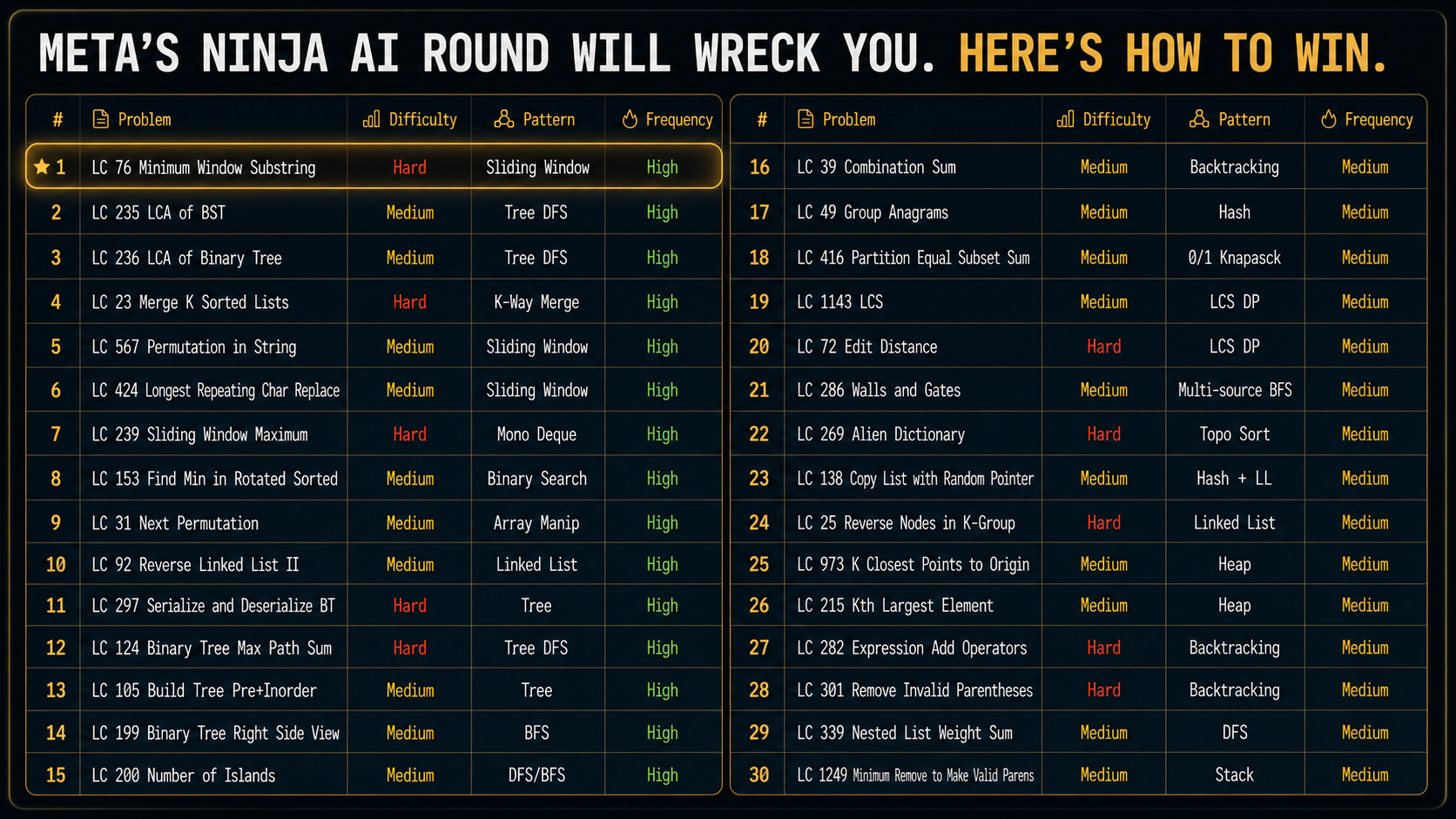
Pattern distribution at Meta:
- Trees + BFS/DFS: ~30% of Meta questions
- Sliding Window: ~15% (Meta loves sliding window)
- Linked Lists: ~12%
- Backtracking: ~12%
- DP: ~10%
- Heap / K-Way: ~8%
- Other: ~13%
Meta as your target? Prioritize sliding window, trees, and backtracking. See the Sliding Window Pattern Guide.
The phone screen (45 min)
Format:
- 5 min behavioral preamble + role context
- 30-35 min coding (1-2 problems)
- 5 min Q&A
Meta phone screens run unusually fast-paced. They often ask 2 problems in the time other companies ask 1. Pace yourself: 18 min for problem 1, 15 min for problem 2.
Onsite Round 1: Ninja (AI-disallowed coding, 45 min)
Standard coding round, AI banned, active proctoring.
What Meta interviewers look for:
- Speed. Meta wants you to land the problem cleanly in 18-22 minutes of code time.
- Edge case completeness. Meta interviewers run your code mentally on multiple inputs. They probe for missed edge cases.
- Articulation under pressure. Can you talk while typing without losing the thread?
Meta's interview style is famously fast-paced. Don't take long thinking pauses. Keep narrating.
Onsite Round 2: Ninja AI (AI-paired coding, 45 min)
The 2024-introduced AI-paired round. You use Claude or GPT-5.4 of your choice.
What Meta interviewers look for in the AI-paired round:
- Prompt quality. Can you frame the problem so the AI gives a useful answer on first try?
- Acceptance discipline. Do you read the AI's output critically before pasting?
- Recovery. When the AI gives a wrong-direction answer, can you redirect in 30 seconds?
- Articulation. Can you compress the AI's verbose output into your own words?
- Strategic delegation. Which subtasks do you give to AI versus keep in your head?
Per recruiter feedback from /u/meta_recruiter_2025, candidates who score highest in the AI-paired round share three habits:
- They read every AI output line by line before accepting.
- They explicitly comment on the AI's mistakes when they spot them.
- They use AI for boilerplate and edge-case enumeration but drive the algorithmic design themselves.
Top scorers in the Ninja AI round delegate boilerplate but never delegate the algorithmic design. The interviewer is grading your judgment, not the AI's output.
FaangCoder voice-mode pairs you with Claude 4.7 for AI-paired round practice. Same Claude an Anthropic interviewer would evaluate you against. Same workflow Meta evaluates.
Onsite Round 3: Pirate (System design, 45 min)
System design round. E5+ standard. E4 gets a scaled-down version.
Use the RESHADED framework. Common Meta SD prompts:
- Design Instagram (the canonical fanout problem)
- Design Facebook News Feed (variant of Instagram)
- Design WhatsApp (real-time messaging)
- Design Facebook Live (live streaming)
- Design Facebook Marketplace (geosearch + recommendation)
- Design Notification System (for news feed alerts)
Meta-specific deep-dive emphasis: fanout strategies (push vs pull vs hybrid), celebrity-shard mitigation, real-time consistency requirements.
Onsite Round 4: Jedi (Behavioral, 45 min)
The Meta behavioral round. Move-Fast story is required.
The Move-Fast story should demonstrate:
- You shipped despite incomplete information.
- You pivoted when org priorities changed.
- You learned from the post-ship outcome.
Other common Meta behavioral questions:
- "Tell me about a project where the requirements changed mid-way." (Adaptability)
- "Describe a time you disagreed with a peer." (Engagement, not avoidance)
- "Tell me about a time you owned something nobody asked you to own." (Ownership)
- "Describe your most impactful project at your current company." (Impact orientation)
Use the behavioral pillar's STAR-L framework. Cross-tag stories to Meta's values. Move Fast, Be Bold, Focus on Impact, Be Open, Build Social Value.
Leveling rubric E3-E7
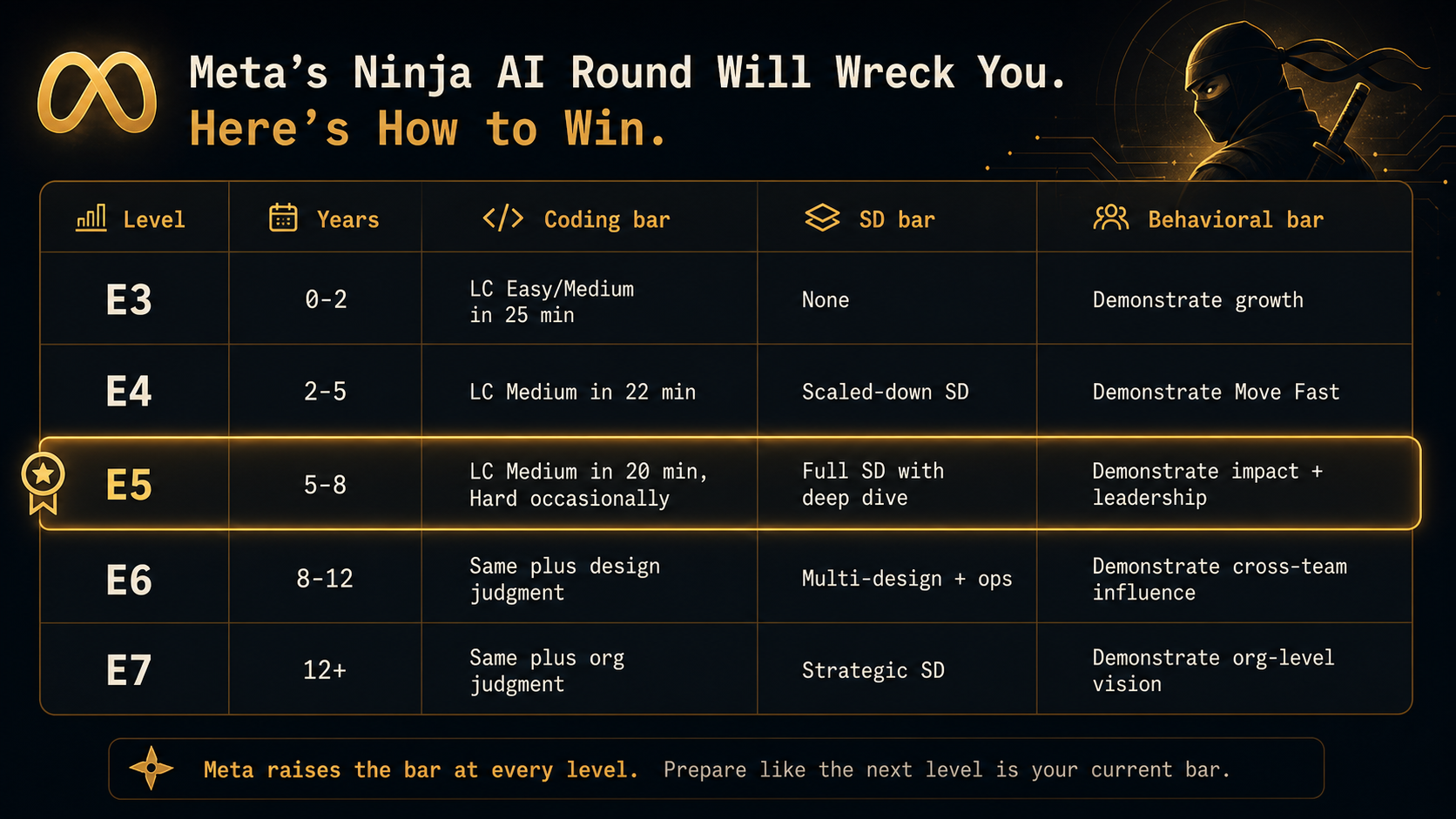
The Meta E5 bar is calibrated similarly to Google L5. Cross-company moves at the same level are common.
Meta-specific prep plan (8 weeks)
Meta as your target? An 8-week sprint:
- Week 1-2: Patterns + Top 30 Meta LC list. Heavy emphasis on sliding window + trees + backtracking.
- Week 3-4: Continue Top 30 + system design primer (RESHADED + 3 fanout-style designs).
- Week 5: Move Fast behavioral library (8 stories + cross-tagging to Meta values).
- Week 6: AI-paired coding round practice with FaangCoder voice-mode. 4-6 mocks minimum.
- Week 7: Mock interviews. interviewing.io paid mocks for calibration.
- Week 8: Taper. 1 mock per day.
For the broader 16-week plan, see How to Prepare for a FAANG Interview.
What to skip for Meta
Don't waste time on:
- Heavy graph theory (Meta asks graphs less than Google).
- Bit manipulation (~1% of Meta questions).
- Amazon-style 16 LP behavioral library (different rubric).
- Cracking the Coding Interview's matrix chapter. Overlap with Meta rotation is minimal.
Common Meta interview mistakes
After watching candidates fail Meta loops:
Mistake 1: Slow pace. Meta phone screens often have 2 problems. Take 25 min on problem 1 and you fail.
Mistake 2: Underprep on sliding window + backtracking. These two patterns combined hit ~25% of Meta's question pool.
Mistake 3: Performative AI refusal in Ninja AI round. Per our 2026 shift analysis, refusing AI reads negatively at Meta especially.
Mistake 4: Generic Move-Fast stories. "We shipped fast" without specifics. Fix: include the org-priority-shift detail.
Mistake 5: Over-articulating in coding rounds. Meta wants you to code, not lecture. 30-second articulation chunks, not 3-minute monologues.
FAQ
How hard is the Meta interview compared to Google/Amazon? Faster paced than Google. More technically demanding than Amazon. Less behavioral weight than Amazon.
Which AI can I use in the Ninja AI round? Your choice. Claude, GPT-5.4, Gemini, even Cursor. Practice with one and stick to it.
Do I need to know React / GraphQL / PHP for Meta? Only if applying for a frontend or specialty role. The general SWE loop is language-agnostic.
Is the Move Fast story really required? You'll be asked behavioral questions in the Jedi round, and at least one will trigger a Move-Fast-themed answer. Have one ready.
What's the most important Meta round? For E4: Ninja and Ninja AI (the two coding rounds). For E5+: Pirate (system design) becomes the leveling round.
Can I retry if I get No Hire? Yes, after a 12-month cooldown.
The verdict
The Meta loop in 2026 is fast-paced, AI-aware, and biased toward candidates who blend strong fundamentals with AI workflow fluency. Focus on sliding window + trees + backtracking for coding. RESHADED + fanout-style designs for SD. Move-Fast story library for behavioral. The Ninja AI round is the differentiator. Practice it specifically.
If you found this useful, FaangCoder helps candidates iterate to optimal solutions in real interviews. That includes Meta-specific AI-paired round practice with Claude 4.7. $399 lifetime ($199/mo monthly option). See the Solve demo, or join the Discord to talk to other candidates prepping for Meta.